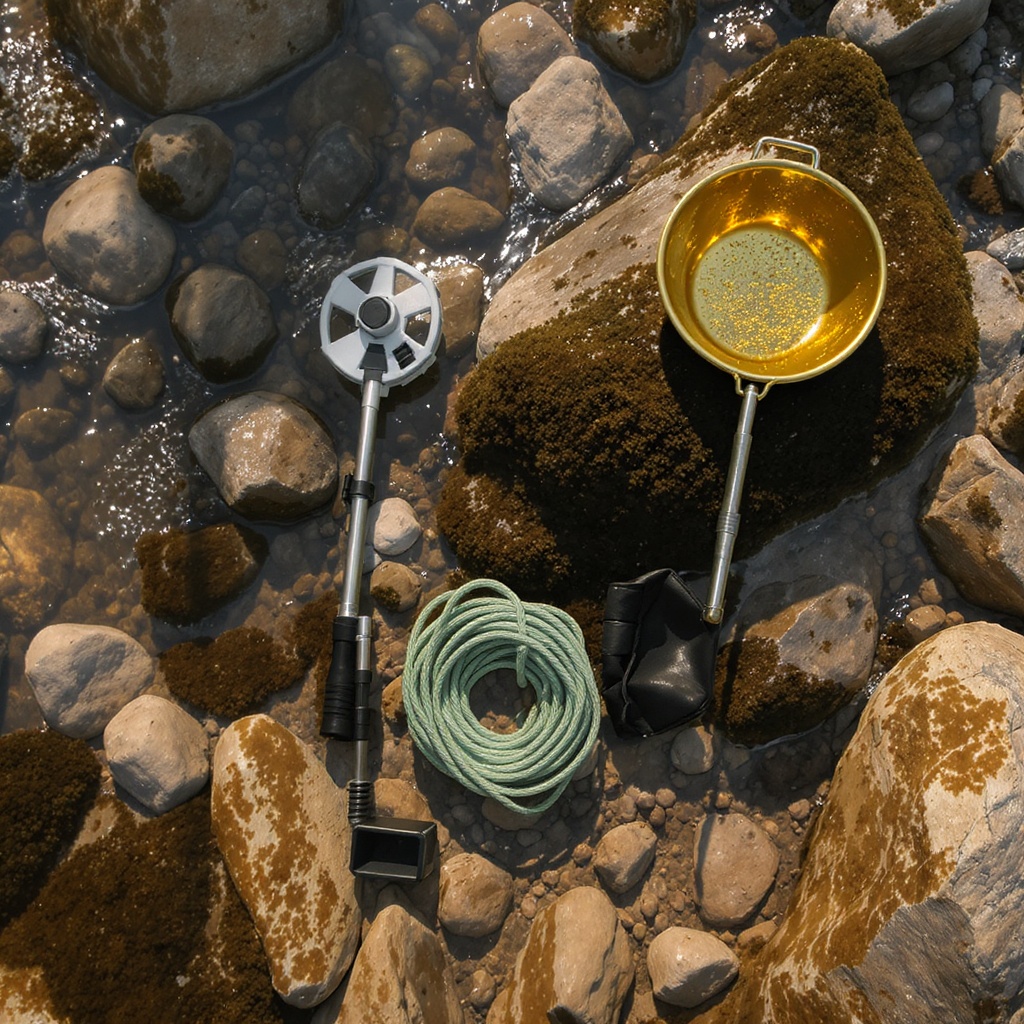
The Arkansas Ozarks aren't California. The gold is finer, the creeks are shallower, and the geology is different — cherty limestone, scattered quartzite, not the hard-rock mother lode country of the Sierra Nevada.
That means different gear. A Colorado River sluice built for high-pressure water will get clogged or washed out on a gentle Ozarks fork. A $50 pan from a big-box store will rust out by November. And a detector tuned for large nuggets will miss the flour gold that Ozarks prospectors actually find.
Below are 8 pieces of gear we've tested on actual Arkansas creeks — the South Fork of the Little Red, the Buffalo River tributaries, the creeks around Jasper and Harrison. If it's on this list, we've used it in the field. No sponsored placements.
Gold Pans & Sluice Boxes
Garrett 14" Gravity Trap
Key Specs
| Size | 14-inch diameter |
| Material | Polypropylene, riffle-textured base |
| Riffles | 6 gravity-trap riffles, raised design |
| Weight | 14 oz |
| Color options | Black, green, red |
| Best for | Fine gold, clay-free streams |
Pros
- Riffles hold fine gold even when the pan is nearly full
- Light enough for all-day use; won't rust
- Wide available stock, fast shipping from MetalDetector.com
- Ribbed base works well with the fine flour gold found in Ozarks tributaries
Cons
- Not ideal for clay-heavy material — gets gummed up
- 14" is fine for most, but larger hands may prefer a 16"
Keene 151 Sluice Box
Key Specs
| Dimensions | 30" × 5.5" opening |
| Material | Aluminum, rubber riffle mat |
| Weight | 3 lbs |
| Flow rate | Works in water as shallow as 1" |
| Setup | Drop in classifier + flow mat, deploy in current |
| Best for | Processing 5–20 gallons of material per day |
Pros
- Processes 10× more material than a pan in the same time
- Light enough to hike in; 3 lbs total
- Works in very shallow water — important for Ozarks tributaries where water depth varies
- Riffle mat is replaceable; extends product life significantly
Cons
- Requires a classifier screen to prevent clogging
- Not ideal for heavily clay-laden material
- Takes a few outings to learn optimal water flow and angle
Metal Detectors
Garrett ACE 400i
Key Specs
| Frequency | 10 kHz (good all-round, fine gold friendly) |
| Target ID | 0–99 digital scale |
| Coil | 8.5" × 11" elliptical DD (included) |
| Iron resolution | 40-segment iron segment display |
| Ground balance | Fixed, auto-ground balance |
| Battery | 4× AA |
| Weight | 2.8 lbs |
| Best for | Ozarks creeks, shallow bedrock, quartz outcroppings |
Pros
- 10 kHz frequency is sensitive to small gold targets — most detectors in this price range are 6.5 kHz
- 40-segment iron discrimination lets you reject trash iron without losing small non-ferrous targets
- Proportional audio and iron volume controls help distinguish gold signals from hot rocks
- Iron Bias feature specifically helps in Ozarks geology where hot rocks (iron-stained quartzite) are common
- Strong Garrett dealer support through MetalDetector.com
Cons
- No manual ground balance — fixed auto-balance struggles in heavily mineralized areas
- Entry-level construction: the control box isn't waterproof, only splash-resistant
- If you move up to serious gold prospecting later, you'll want a dedicated gold detector (Fisher, Minelab)
Minelab Go-Find 22
Key Specs
| Frequency | 7.8 kHz |
| Target ID | Visual icons (not numerical) |
| Coil | 8" closed coil (waterproof) |
| Discrimination | 3-mode (all-metal, coins, jewelry) |
| Ground balance | Fixed |
| Battery | 4× AA |
| Weight | 2.2 lbs — lightest in class |
| Best for | First-time buyers, kids, casual creek walks |
Pros
- Collapses to 22" — fits in a backpack, easy to store
- Fully waterproof coil — can wade creeks without worry
- Cheapest entry into actual detection — not a toy but not overwhelming
- Smartphone app companion for settings — useful for beginners
Cons
- 7.8 kHz is too low to reliably detect fine gold flakes — you'll miss the primary Ozarks find
- Icon-based target ID is imprecise — hard to tell a coin from a pulltab
- No adjustable threshold or iron volume — frustrating in trashy areas
- Best as a gateway detector, not a permanent tool
Hand Tools
Estwing 22 oz Rock Pick
Key Specs
| Weight | 22 oz head, 1.5 lb total |
| Material | Forged steel, fully polished |
| Handle | Shock-absorbing nylon vinyl grip |
| Length | 13" |
| Sheath | Full-grain leather, belt loop |
| Best for | Breaking rock, prying clay, prospecting crevices |
Pros
- One-piece forged construction — no weld failure, ever
- The shock-absorbing grip is not just comfort; it actually protects your wrist on hard rock
- Leather sheath is worth $15 alone — most competitors cheap out on this
- Flat back for striking; point for precision work — both useful on the creek
Cons
- 1.5 lbs adds up over a long day — but that's the minimum for useful rock-breaking
- Nylon grip gets slick when wet — leather gloves help
Fiskars 4-Claw Digger
Key Specs
| Material | Hardened steel tines, welded construction |
| Handle | Polypropylene, no-slip grip |
| Length | 15.5" |
| Weight | 1.2 lbs |
| Best for | Clay, compacted gravel, thick vegetation root systems |
Pros
- Four tines break through Ozarks clay layers in one motion — faster than a pick
- Slides into crevices and narrow cracks that a shovel can't fit into
- Handle grip stays secure even when covered in creek mud
- Durable — these last years of hard use with no maintenance
Cons
- Not useful for solid rock — purely for clay and loose material
- Small scoop volume — not for bulk material movement
Accessories
Garrett Crevice Tool
Key Specs
| Length | 17" |
| Tip | Double-end scraping tip |
| Material | Hardened steel, brass-plated |
| Weight | 4 oz |
| Best for | Quartzite crevices, bedrock cracks, narrow spaces |
Pros
- Ozarks bedrock has deep cracks that trap fine gold — this gets into those cracks where nothing else fits
- 17" length lets you reach into deep crevices without reaching in yourself
- Double-end design — flat edge for scraping, point for precision
- Cheap enough to keep a spare in the car
Cons
- Tip can bend if used as a pry bar — use as intended
SE Gold Gathering Vials + Loupe
Key Specs
| Quantity | 6 vials, 1.5" × 3" each |
| Material | Heavy-gauge plastic with screw-top lids |
| Magnifier | 10× jewelers loupe with LED |
| Label area | Pre-printed labels for creek, date, weight |
| Best for | Storing, sorting, and documenting gold finds on-site |
Pros
- The 10× LED loupe is genuinely useful — can confirm gold vs. mica on the creek, no need to wait until you get home
- 6 vials means you can separate finds by location, date, or gold quality
- Labels for creek name + date help track productive spots over time
- Small enough to keep in a vest pocket
Cons
- Screw tops can loosen if dropped — put a piece of electrical tape over the thread for long-term storage
Common Ozarks Gold Questions
Generally yes, on public land. Arkansas allows recreational gold prospecting on most US Forest Service land and Arkansas State Parks (with park-specific rules — check before you go). You cannot prospect on Arkansas Game and Fish Commission properties without a specific permit. Private land requires explicit permission from the landowner. Do not prospect in designated Wilderness Areas, which prohibit mechanized equipment. The short version: surface prospecting with pans and hand tools is broadly legal on Forest Service land, but do your homework on specific creek permissions before heading out.
Panning processes material you've already dug — you're looking at what gravity concentrates from a scoop of creek sediment. Metal detecting finds targets already in the ground without digging. For the Ozarks specifically: panning is more reliable because fine gold is distributed through streambed sediment rather than concentrated in large nuggets. Metal detectors work well near old mining sites and quartz outcroppings where gold may have settled in bedrock cracks. Most serious Ozarks prospectors do both — detect to locate promising spots, then pan to process material.
Late summer through early fall is ideal. Water levels are lowest (July–October), making creeks easier to work. June and early July can work well too if we haven't had heavy rain. Winter works but cold water makes panning miserable. Spring (March–May) tends to have high water and muddy conditions from snowmelt and rain. If you can choose, pick a dry summer after a dry spring — the creeks are clearest and lowest.
Be realistic. The Arkansas Ozarks produce fine gold, not large nuggets. A good day of dedicated panning might yield $20–$50 worth of gold by weight (1–3 pennyweights). Some days you'll find nothing, especially in popular areas that have been worked repeatedly. The goal for most recreational prospectors isn't profit — it's the experience of finding something ancient in your hands. Treat it as a hobby, not an income stream.
No. A $35 gold pan, an Estwing pick, and a pair of leather gloves will get you further than a $1,000 detector in the hands of someone who doesn't know how to use it. Start with the basics (the Garrett pan, the rock pick, and a pair of sturdy boots) and add gear as you learn what you actually need. The most expensive mistake in this hobby is buying equipment for a type of prospecting you don't end up doing.